Before there were bubbles, there was bhang. Before there were sleek little cans in your cooler, there were steaming herbal infusions in sacred temples and back-alley apothecaries. Your favorite THC seltzer didn’t just appear out of nowhere.
For thousands of years, cannabis has been brewed, blended, and blessed into drinks for everything from menstrual cramps and malaria to spiritual awakening and psychedelic potlucks. It’s been medicine, myth, ritual, and resistance. And now? It’s in your fridge.
In this blog, we’re tracing the fizzy, freaky, fabulous evolution of cannabis drinks, from ancient China’s tea scrolls to India’s divine milkshakes, through corset-era tinctures and hippie mason jars, all the way to the modern THC seltzer you’re sipping like a hydration baddie with a PhD in chill.
So grab a can and settle in. Let’s take a look.

Ancient China (1000 BCE+): The Original Herbalist Era
Long before cannabis was controversial, it was just...medicine. Like, scroll-worthy, emperor-approved medicine.
Let’s rewind to ancient China, where herbalists were out here compiling texts like the Shennong Bencaojing, which studies 120 herbs and substances of use to humans, with plants that have "stimulating properties", like Cannabis, labeled as "noble" or "upper herbs". It’s named after Shennong (神农), or ‘Divine Farmer’, one of the Three Sovereigns, a group of mythological rulers and deities from ancient China circa 2852 to 2070 BC who established the Chinese life-arts. Said to have been born the son of a princess and a heavenly dragon, Shen Nong is believed to have taught the ancient Chinese their practices of agriculture, as well as the use of herbal drugs, which became the foundation of traditional Chinese medicine. , the mythical father of Chinese medicine, who allegedly taste-tested hundreds of herbs so we didn’t have to. (King behavior.) Among them? Cannabis, aka ma (麻).
The Chinese weren’t rolling joints (mainly because ancient cannabis wasn’t the turbo-charged THC bomb we know today). Instead, they were brewing cannabis teas. Read: hot leaf and stem water a la ancient apothecary. These infused tonics were used to “treat” everything from:
- Gout
- Rheumatism
- Malaria
- Constipation
- Menstrual cramps
- Even childbirth pain relief (shoutout to the real ones who thugged it out before the epidural was invented, btw)
Cannabis was seen as a warming plant that helped move stagnation through the body, which was a major theme in traditional Chinese medicine. Basically, if your qi was stuck, cannabis came in with the gentle push of a warm mug and a vibe check.
Even back then, they knew that ingesting cannabis had a different effect than smoking it. It was less intoxicating up front but had deeper, longer-lasting effects. Aka, the original edible experience. Ancient herbalists walked so we could run.

India (1000 BCE–present): Bhang and the Divine Milkshake
While ancient Chinese herbalists were steeping cannabis for balance and flow, Indian texts named it one of the five sacred plants. Cannabis became a botanical VIP associated with happiness, liberation, and clarity.
Enter bhang: a creamy, cooling drink made from cannabis leaves, milk, ghee, spices, and sugar. For over 3,000 years, bhang has been served during festivals like Holi and Maha Shivaratri, offered in devotion to Lord Shiva, the Hindu deity of transformation and meditation. In this context, cannabis isn’t about getting high; it’s about getting closer. To stillness, to spirit, to something bigger than yourself.
Ayurvedic medicine, one of the oldest wellness systems in the world, also made space for cannabis, prescribing it for anxiety, digestion, fever, and more. But ancient healers made one thing clear: it’s never about indulgence, and it’s always about intention. Back then, bhang was used to:
- Cleanse sins
- Elevate consciousness
- Ease anxiety and digestive distress
- Help with fever, fatigue, and sunstroke
But the underlying rule was to always dose wisely, respect the plant, and remember that not every vibe is meant to be chased.
These days, bhang still exists in parts of India thanks to a technicality: it’s made with the leaves, not the resin, which makes it legal in some states and available in government-regulated shops. But it’s complicated. For some, bhang remains a sacred tradition. For others, it flirts a little too closely with recreational use. And like much of modern cannabis culture, that line between reverence and regulation is still being negotiated.

Europe & The Early U.S. (1800-1900s): The Prescribed Protocol
In the 1800s, cannabis wasn’t counterculture; it was common sense.
Queen Victoria was reportedly prescribed a cannabis tincture by her royal physician, Sir J. Russell Reynolds, to ease menstrual cramps (we love that for her.) The same doctor later wrote, “When pure and administered carefully, [cannabis] is one of the most valuable medicines we possess.”
In Scandinavia, pharmacies carried a malted cannabis drink called Maltos-Cannabis, marketed to improve digestion and vitality. Ads for it even appeared in American newspapers targeting Scandinavian immigrant communities, proof that cannabis wellness was crossing oceans in more ways than one.
Meanwhile, over in France and Spain, cannabis was being used to treat insomnia, asthma, migraines, and even the pain of childbirth. And in the U.S. we were bottling the stuff by the gallon.
Brands like Eli Lilly, Parke-Davis, and Squibb were selling cannabis-infused syrups, lozenges, tinctures, and elixirs over the counter with no prescription needed. Just head to your local drugstore and grab a bottle of cannabis tonic for your headache. You could usually find it right next to the cocaine drops for toothaches and heroin-laced cough syrup. ✨wow✨
It was, in no uncertain terms, a lawless time for medicine. The only rule was: if it fits in a bottle, it’s medicine. And those bottles? Usually filled with alcohol, opiates, stimulants, and a heavy pour of THC.
Victorian wellness girlies weren’t sipping, they were soaking. Corseted, overwhelmed, and absolutely LOST in the theoretical sauce, they turned to cannabis not to get high, but to feel normal in a century that didn’t believe in anesthesia, therapy, or chill.
All of this came crashing down in 1937 with the Marihuana Tax Act, which made cannabis federally restricted in the U.S. Overnight, it went from a trusted remedy to a feared substance that even doctors could no longer prescribe.

1960s–70s U.S.: Hippies, Homebrews & High Times
By the time the 1960s rolled around, cannabis drinks had gone off-label and underground, steeped in psychedelic rebellion and DIY spirit. With cannabis banned and the vibes severely policed, people did what they do best. They got weird, and they got crafty.
Instead of grabbing a tincture from the pharmacy, you might’ve found yourself stirring weed into boiling milk in a commune kitchen, following a handwritten recipe from a zine passed around at a protest. Recipes for weed tea, psychedelic lassis, and THC beer brews were quietly shared through underground cookbooks like The Hashish Cookbook and The Alice B. Toklas Cookbook (which was technically published in 1954 but still became a counterculture classic).
Cannabis drinks during this time were about more than just getting high. They were for:
- Pain relief and comfort
- Creative exploration
- Spiritual awakening
- Communal bonding
- Rejecting conformity
But that last part? It was the core.
By the mid-20th century, American culture was buttoned-up, sanitized, and hyper-controlled. War was glorified, conformity was rewarded, and stepping outside the box could cost you your job, your reputation, or worse. Against that backdrop, the hippie movement rose as a rejection of it all: capitalism, war, segregation, rigid gender roles, nuclear family pressure, spiritual disconnection… You name it, they protested it.
And cannabis was a symbol. A plant the government told you not to touch. A consciousness-altering force in a culture obsessed with control. Drinking it became a quiet act of rebellion. Brewing it was ritual-meets-resistance.
It showed up at anti-war protests, love-ins, consciousness-raising circles, and any party where someone was definitely playing the sitar. It was a way to slow down, tune in, and challenge everything you’d been told to believe.
Somewhere between the incense and the anti-war chants, a new kind of cannabis drink emerged. One that wasn’t sold in stores or prescribed by doctors. It was homemade. Handed down. Shared freely. And it served as a kind of liquid manifesto.
This era wasn’t sleek or sterile. It was messy, mystical, and deeply intentional. People weren’t just consuming cannabis, they were reclaiming it. And drinks were a huge part of that magic.

Present Day: The Seltzer Awakens
Between the love-ins and the lab coats, something happened: The War on Drugs. And (shocker)… the drugs won.
After decades of prohibition, fearmongering, and political PR campaigns, cannabis is finally being welcomed back into the conversation, not as a rebellious indulgence, but as something useful. Therapeutic. Intentional.
It’s almost like… we’ve been here before.
From ancient teas to temple milkshakes to corset-era tinctures, humanity’s relationship with cannabis has always existed. We just buried it under bureaucracy and some really bad headlines.
But now?
We’re back, baby. And we’re doing it differently.

Today’s Cannabis Drinks
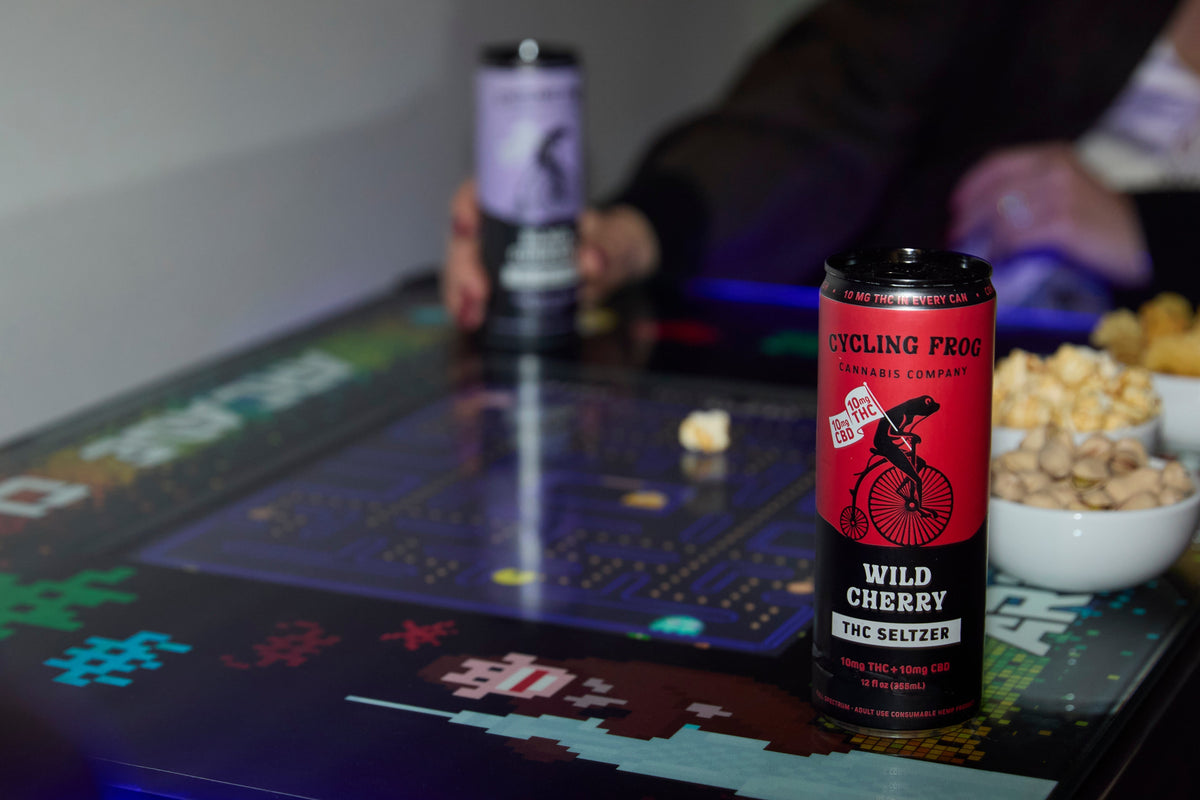
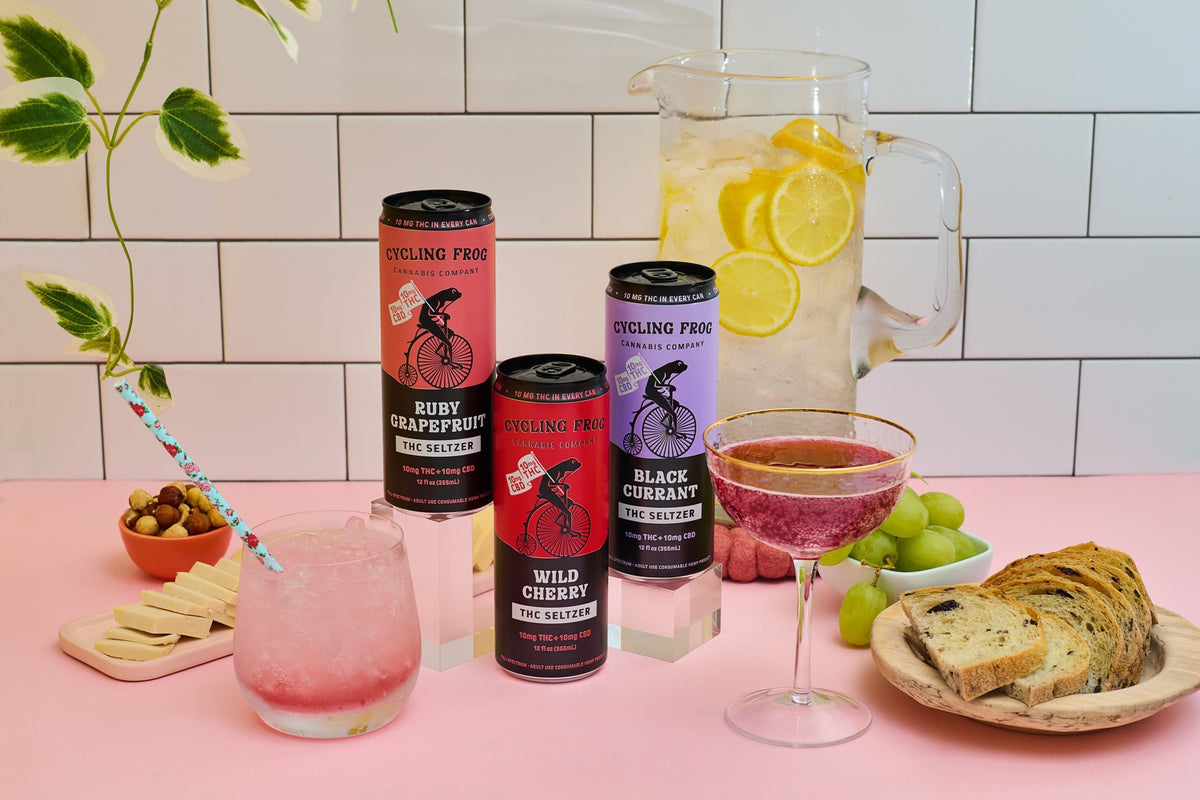
Today’s cannabis drinks are sleek, social, and scientifically smarter. We’re not just throwing raw flower into butter and guessing anymore. A lot of brands (including Cycling Frog 😉🐸) use modern nano-emulsification technology to break THC into tiny, water-soluble particles. That means faster onset, better absorption, and consistent effects every time.
More and more people are walking away from alcohol. Not because they don’t want to relax and cut loose once in a while, but because they want to feel better doing it. There’s a growing sober-curious and wellness-forward movement that sees modern THC drinks as the best of both worlds: the intentionality of ancient remedies, the freedom of 70s rebellion, and the clarity of modern science.
Let’s be real: we’ve known alcohol is bad for us for decades. It wrecks sleep, drains energy, fuels anxiety, and rarely leads to good decisions. So why are we still acting like it’s the default? Cannabis drinks say, “What if the good time didn’t come with a hangover?” And honestly… they’re onto something.
We’ve learned that cannabis can support wellness, mentally, physically, and socially. But we’ve also learned what happens when things go untested. In the 1800s, cannabis sat on the shelf next to cocaine drops and heroin syrup. No safety standards. No ingredient lists. Just vibes.
But we know better now.
That’s why lab testing matters, why COAs should be non-negotiable, and Why you should only trust brands that prove their products are clean, consistent, and free from pesticides, solvents, and heavy metals.
Cannabis may be ancient, but this version’s built to last.